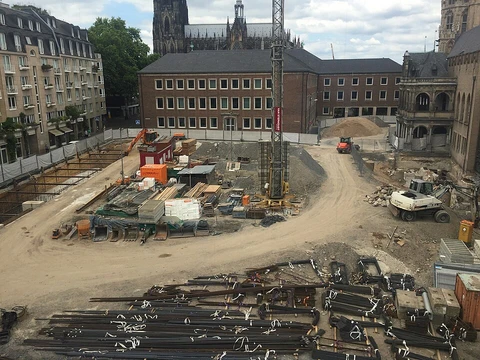
Concrete
Second-most-used substance after water; most-manufactured material worldwide.

Concrete is a composite material composed of aggregate bound together with a fluid cement that cures to a solid. It is the second-most-used substance after water, the most widely used building material, and the most-manufactured material in the world. Concrete has been used in construction since ancient times, with notable examples from Greek, Nabatean, Roman, and Mayan civilizations, and its modern form relies primarily on Portland cement.
- field
- Building material
- known_for
- Most widely used building material; second-most-used substance after water
- composition
- Aggregate bound with cement (typically Portland cement) that hardens via hydration
- modern_innovation
- Reinforced concrete with steel rebar for tensile strength
Lore & Background
Concrete is a composite material made from aggregate bound with a fluid cement that cures to a solid. When aggregate is mixed with dry Portland cement and water, it forms a slurry that can be poured and molded. The cement reacts with water through hydration, an exothermic process that hardens the material over several hours. Additives such as pozzolans or superplasticizers may be included to modify properties. Most structural concrete is reinforced with steel rebar to provide tensile strength, yielding reinforced concrete. Before Portland cement was invented in the early 1800s, lime-based cement binders like lime putty were common. Roman concrete (opus caementicium) had compressive strength similar to modern concrete but lacked reinforcement, limiting tensile strength. Its durability is attributed to pyroclastic materials that form Al-tobermorite crystals when reacting with seawater, and to hot mixing that creates self-healing lime clasts. Medieval concrete saw a decline in quality in some regions due to low kiln temperatures and lack of pozzolana, but hydraulic mortars were made using crushed ceramics or volcanic soils. Concrete is distinct from mortar (which contains only fine aggregates) and grout (which lacks coarse aggregates and is used to fill gaps).
Reader's Guide
Concrete is the most-manufactured material in the world and the second-most-used substance after water, making it foundational to modern infrastructure. Its significance lies in its versatility: it can be poured into forms, tooled, and reinforced with steel to create structures with both compressive and tensile strength. The invention of Portland cement in the early 1800s revolutionized concrete production, allowing for consistent, high-strength material. Ancient Roman concrete demonstrated remarkable durability, with structures like the Pantheon and Colosseum surviving for millennia, partly due to self-healing properties from pyroclastic materials and hot mixing. Modern concrete differs from Roman concrete in its fluid, homogeneous mix and integral steel reinforcement. The legacy of concrete includes its role in enabling complex architectural designs, from Roman arches and domes to contemporary skyscrapers and bridges. Its environmental impact, though not detailed here, is significant due to high production volumes. Concrete's distinction from mortar and grout clarifies its specific uses in construction.
Did You Know?
- Concrete is the second-most-used substance in the world after water.
- Roman concrete (opus caementicium) had compressive strength similar to modern Portland-cement concrete, around 200 kg/cm² (20 MPa).
- The Pantheon in Rome has the world's largest unreinforced concrete dome.
Frequently Asked Questions
What exactly is Concrete?
Concrete is a composite building material made by mixing aggregate (like sand and gravel) with a fluid cement—usually Portland cement—and letting it harden through a chemical process called hydration. Once cured, it forms a solid mass strong enough to bear enormous structural loads.
Why is Concrete considered the most important building material?
It holds the title of the most widely used building material on Earth and ranks as the second-most-used substance after water. It is also the most-manufactured material globally, making it the backbone of virtually every modern infrastructure project.
What's the difference between ancient and modern Concrete?
Ancient versions relied on locally available lime-based binders, while modern concrete is built around Portland cement as its primary binder. The biggest modern leap came with reinforced concrete, which embeds steel rebar inside the mix to handle tensile forces that plain concrete alone cannot resist.
What does Concrete actually do in a building?
It provides compressive strength, structural mass, and a durable, moldable surface that can be poured into virtually any shape. When paired with steel reinforcement, it becomes the go-to solution for foundations, beams, slabs, and load-bearing walls in both residential and large-scale construction.
More in Construction & Materials 1-19
Spotted an error? Know more?
This is a living reference — every entry is fact-audited, and reader corrections feed straight into our audit queue. Suggest an edit · See this site's audit record